


Walking Into a World We Pretend Not to See
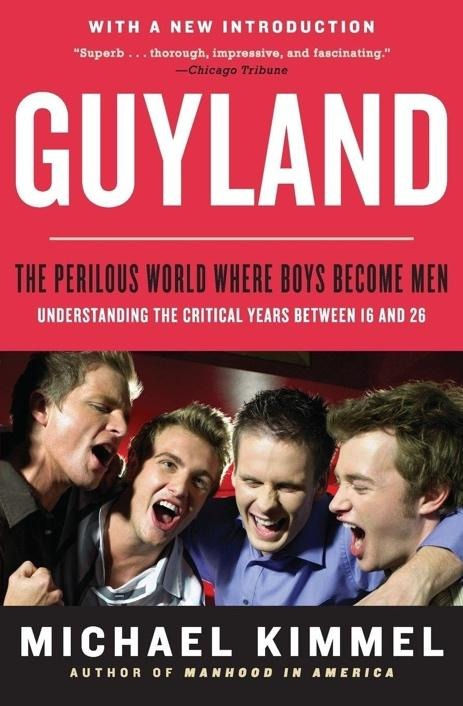
Some books feel like discoveries. Others feel like recognitions.
Reading Guyland, I kept having the sense that Michael Kimmel was naming something many of us already knew, had lived through, or were still negotiating, but had never fully articulated. Not because we lacked insight, but because the world he describes often hides in plain sight. It disguises itself as humor. As normal. As “just how guys are.”
Guyland is not a book about individual failure. It is a book about a social world. A world that young men enter early, inhabit for years, and struggle to exit without clear guidance, language, or support. Kimmel invites us not to pathologize that world, but to examine it carefully, relationally, and honestly.
For those of us who work with adolescents, young adults, or men navigating identity, this book reads less like a critique and more like a map. Not a map that tells us where to go, but one that helps us understand where we already are.
Guyland Is Not a Phase, It Is a System
One of Kimmel’s most important moves is refusing to treat Guyland as merely immaturity or delayed development. Instead, he positions it as a distinct social system with its own norms, rituals, rewards, and punishments.
Guyland operates according to an unwritten code. Emotional restraint is valued. Vulnerability is suspect. Sexual experience functions as currency. Loyalty to male peers outranks nearly every other relational commitment. And above all, there is a constant pressure to perform masculinity in ways that are legible to other men.
This framing matters. When we call Guyland “a phase,” we imply inevitability and harmlessness. When we understand it as a system, we can begin to see how behavior is shaped less by personality and more by survival within a particular relational economy.
From a therapeutic or educational lens, this shifts the question. We are no longer asking, “Why won’t he grow up?” We are asking, “What would it cost him to step outside this world?”
Belonging at a Price
What struck me most is how deeply Guyland is about belonging. Not intimacy. Not connection. Belonging.
Kimmel describes young men surrounded by peers, yet profoundly alone. Friendships are plentiful, but emotional safety is scarce. To be known too deeply is to risk ridicule, exclusion, or suspicion. Care must be masked as humor. Pain must be converted into irony. Fear must be denied altogether.
This is where Guyland begins to feel especially relevant for clinicians. Many men arrive in therapy fluent in deflection, sarcasm, or intellectualization, yet unsure how to speak directly about loss, uncertainty, or shame. Kimmel’s work helps us see that this is not resistance, but training.
Guyland teaches men how to survive other men.
It also teaches them what not to say.
The Emotional Economy of Masculinity
Kimmel repeatedly shows how masculinity in Guyland is policed not through explicit rules, but through constant relational surveillance. Who drinks the most. Who gets laughed at. Who hooks up. Who gets called out. Who gets ignored.
Masculinity here is not something one has. It is something one must continuously prove.
And proof is fragile.
What emerges is a version of masculinity built on anxiety rather than confidence. On performance rather than integration. On avoiding shame rather than pursuing meaning.
This has profound implications for mental health. If emotional expression is coded as weakness, then distress must either be externalized or numbed. If asking for help risks status loss, then suffering becomes private and often invisible.
Again, the question shifts:How many men are struggling not because they lack insight, but because they lack permission?
Women in Guyland, But Never at the Center
Kimmel is careful to show that women do not exist outside Guyland. They live within its orbit, adapt to its expectations, and bear many of its consequences. Yet they are rarely allowed to define its terms.
The sections on hookup culture, pornography, and sexual entitlement reveal a world in which women are often positioned as props in male bonding rather than full relational partners. Equality, when it appears, often takes the form of women accommodating male comfort rather than reshaping relational norms.
What I appreciated is Kimmel’s refusal to flatten these dynamics into villains and victims. Instead, he situates them within broader cultural messages about sex, power, and worth. Women are navigating Guyland just as men are, often with fewer protections and higher costs.
For therapists and educators, this reinforces the importance of looking at relational patterns rather than individual morality. The issue is not isolated behavior. It is the system that makes certain behaviors seem inevitable.
Delaying Adulthood Without Dignifying It
One of the quieter but more haunting themes in Guyland is how adulthood itself is portrayed. Responsibility is framed as drudgery. Care is feminized. Commitment is seen as the end of freedom.
When adulthood is depicted as joyless obligation, avoidance begins to make sense.
Kimmel situates this within economic precarity, shifting labor markets, and cultural narratives that strip adulthood of meaning. Young men are told they must eventually “man up,” yet are offered few compelling images of what that actually looks like.
This reframing is especially important for educators and parents. If adulthood is experienced as loss rather than expansion, then prolonged adolescence becomes less a failure and more a rational response.
It raises a difficult question:What kind of adulthood are we inviting young men into?
The Cost of Silence
Throughout Guyland, Kimmel returns to the theme of silence. Silence between men. Silence between generations. Silence between institutions and the young people they serve.
Parents withdraw too early. Schools focus on performance over development. Communities assume young men will “figure it out.” And in that absence, Guyland fills the gap.
What emerges is a world where initiation happens peer-to-peer, without guidance or containment. Rituals become increasingly extreme because no adult presence legitimizes the transition. Validation must be earned through endurance rather than recognition.
From a systemic perspective, this is not accidental. It is what happens when societies outsource development to peer culture.
Reading Guyland Through a Relational Lens
Although Kimmel writes as a sociologist, Guyland lends itself easily to relational and systemic frameworks. Identity here is co-constructed. Behavior is context-dependent. Meaning is negotiated through interaction rather than internal trait.
This is where the book quietly aligns with collaborative-dialogic sensibilities, even if it does not name them explicitly. Young men are not simply choosing Guyland. They are responding to it. They are negotiating survival within it.
Change, then, cannot be imposed from above. It must emerge through relationship, conversation, and presence.
Not lectures. Not shame. Presence.
What This Book Asks of Us
Guyland is not a prescriptive book. It does not offer a checklist or a program. Instead, it asks something more difficult.
It asks adults to stay engaged longer.It asks institutions to take development seriously, not just outcomes.It asks men to question which performances they inherited and which ones they want to keep.
And it asks all of us to resist the temptation to reduce complex systems into simple slogans.
“Boys will be boys” is not an explanation. It is a dismissal.
Sitting With the Questions
As I closed the book, I found myself less interested in answers and more attuned to questions that lingered:
What kinds of masculinity are quietly rewarded in our schools and workplaces?
Where do boys learn that care is dangerous?
How do we create spaces where emotional honesty does not cost belonging?
What would mentorship look like if it centered recognition rather than correction?
These are not questions that resolve neatly. They are questions meant to be returned to, again and again, in conversation.
Final Reflections
Guyland endures because it refuses to reduce men to stereotypes or excuses. It holds complexity without collapsing into cynicism. It names harm without abandoning hope.
For therapists, educators, and anyone working relationally with young men, this book offers more than critique. It offers orientation.
It reminds us that masculinity is not a destination, but a negotiation. One shaped by history, culture, economics, and relationship. And if that negotiation happens in isolation, it often hardens into performance.
But if it happens in dialogue, something else becomes possible.
Perhaps the most important contribution of Guyland is not that it exposes a problem, but that it invites us back into relationship with a world many of us were taught to ignore.
And maybe that is where change actually begins.


Comments